

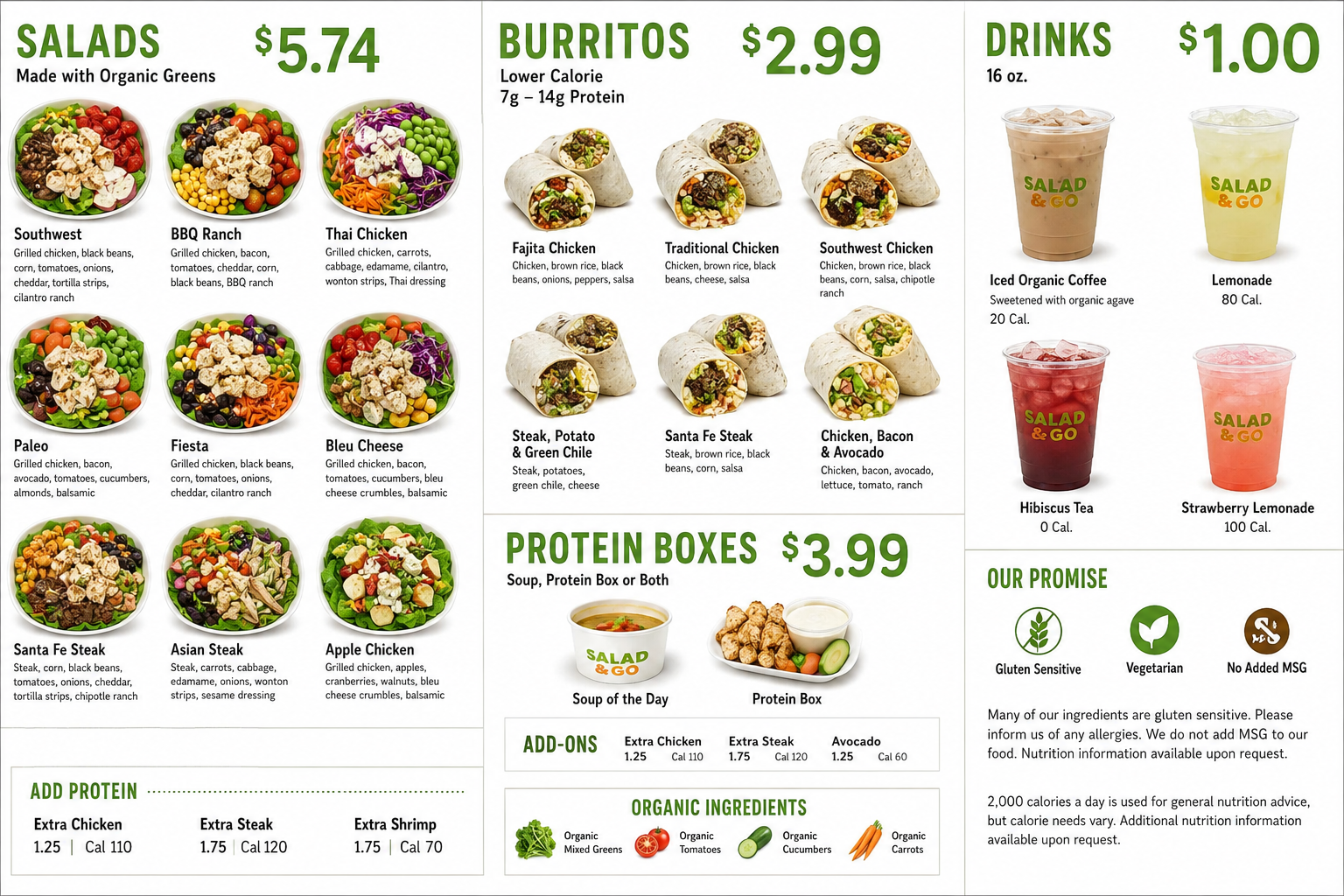



Picture this: you’re starving, stuck between two bad options — a burger joint that’ll leave you sluggish, or packing a lunch you never had time to make. Then you spot a bright green drive-thru sign that promises something different. That’s the whole appeal of Salad and Go, and once you understand how the Salad and Go menu is built, ordering gets a lot less overwhelming.
Unlike a sit-down salad bar where you’re building from scratch, this chain runs on a curated, drive-thru-first model. That means fewer decisions, faster service, and a menu designed to be affordable enough for a daily habit rather than an occasional treat. Below, we’ll walk through every section of the Salad and Go menu, point out the items regulars order on repeat, and share a few tips for getting the most out of your visit.
What Makes This Menu Different From a Typical Salad Chain
Most fast-casual salad spots hand you a bowl and a line of toppings to point at. This concept flips that script. Instead of an assembly line, the Salad and Go menu is pre-built into named combinations — think a short list of signature salads, wraps, and bowls rather than a build-your-own counter. The upside is speed: you pull up, order a number or a name, and you’re out in minutes.
The tradeoff is that customization is more limited than at a traditional salad bar, though most locations will still swap a dressing or hold an ingredient if you ask. If you’re new to the menu, it helps to know that everything is designed around a handful of bases — greens, protein, and dressing — repeated across different flavor combinations. Once that clicks, the whole menu feels a lot smaller and easier to navigate.
Signature Salads: The Heart of the Menu
This is where most first-time visitors start, and for good reason — the salads are the reason the chain exists. A few categories show up again and again:
- Classic combinations like a Cobb-style salad with egg, bacon, and blue cheese, built for people who want something hearty rather than a light side dish.
- Southwest-inspired bowls with black beans, corn, and a chipotle or ranch-based dressing, popular with anyone who wants more kick than a standard garden salad.
- Protein-forward options loaded with grilled chicken, which tend to be the best-seller across most locations because they double as a full, satisfying meal rather than a starter.
A real-life example: a construction worker on a lunch break doesn’t have 20 minutes to sit and eat slowly. Grabbing a protein-heavy salad from the Salad and Go menu, eating it in the truck, and getting back to the job site in under 15 minutes is exactly the use case this business model was built for. Compare that to a working parent picking up dinner for the family — they might order two or three different salads off the same Salad and Go menu, mixing a lighter option for one person with a heartier one for another, all from a single drive-thru stop.
Wraps and Bowls for the Anti-Salad Crowd
Not everyone wants lettuce as the base, and the menu accounts for that. Wraps take the same protein and topping combinations found in the salads and roll them into a tortilla, which makes them easier to eat one-handed — a small detail that matters a lot if you’re eating in the car.
Bowls, meanwhile, tend to swap greens for a grain or a heartier base, giving you something closer to a rice bowl or grain bowl experience. If you’ve ever brought a coworker along who insists “salads don’t fill me up,” this is the section of the Salad and Go menu to point them toward. It’s the same nutritional philosophy — real ingredients, portioned protein, minimal processed filler — just packaged differently for people who want more texture and less green.
Breakfast Items Worth Knowing About
Here’s a detail casual fans often miss: this isn’t strictly a lunch-and-dinner operation. Many locations serve a breakfast menu during morning hours, featuring items like breakfast burritos or bowls built around eggs, cheese, and a protein choice. It’s a smart move on the brand’s part — it captures customers earlier in the day and reinforces the idea that the Salad and Go menu isn’t just a diet-food destination, but an everyday food stop.
A third real-world example: a nurse coming off a night shift might not want a heavy salad at 7 a.m., but a breakfast burrito from the same drive-thru gives her a reason to stop at the same place she already trusts for lunch. That kind of repeat, multi-meal usage is exactly what keeps a fast-casual concept profitable — and it’s worth remembering next time you assume the menu is salads-only.
Sides, Add-Ons, and Small Extras
Beyond the mains, there’s usually a short list of extras — things like a side of fruit, a cookie, or a small soup option depending on the season and location. These aren’t the star of the show, but they matter if you’re trying to round out a meal or feed a picky eater who wants something simple alongside their salad.
Add-ons also apply within each dish. Most locations let you request extra protein, swap a dressing, or ask for something on the side rather than mixed in. If you have a dressing you love and a topping you can’t stand, don’t assume the printed combination is final — asking at the window is usually enough to get a small adjustment.
Dressings and Flavor Profiles to Expect
The dressing lineup is where a lot of the flavor variety on the Salad and Go menu actually comes from, since the greens and proteins repeat across multiple dishes. Expect a mix of:
- Creamy, ranch-style dressings for people who want comfort-food flavor
- Vinaigrette-based options for a lighter, tangier finish
- Spicier, chipotle or southwest-style dressings for the combinations built around that flavor profile
If you’re someone who orders the same salad every week but wants variety without decision fatigue, swapping only the dressing is the easiest way to keep things interesting while sticking to a routine.
Pricing: What to Actually Expect
One of the biggest draws of this concept compared to other salad chains is affordability — pricing is generally positioned closer to a fast-food value menu than a premium salad bar, which is a major part of why the Salad and Go menu has built such a loyal following among people who eat there multiple times a week rather than as an occasional splurge.
That said, exact prices vary by location, region, and time, and they do change — the same way any fast-food menu adjusts pricing over time. Rather than quoting numbers that may already be outdated by the time you read this, the more reliable move is to check current pricing through the location’s ordering app or the drive-thru screen itself before you order. It’s a small extra step, but it saves you from any surprise at the window.
Tips for Getting the Most Value Out of Your Order
A few practical habits make a real difference if the Salad and Go menu is going into your regular rotation:
- Order ahead through the app when possible. It speeds up the drive-thru line and often surfaces current deals or combo pricing you might not see on the menu board.
- Ask about substitutions before you order, not after. If you want a protein swapped or a topping left off, mentioning it upfront avoids remaking the order.
- Mix and match across visits. Because the base ingredients repeat across dishes, trying a wrap one visit and a bowl the next is an easy way to explore the full range of the Salad and Go menu without getting bored of the same three items.
- Watch for regional or seasonal specials. Locations sometimes rotate limited-time salads or bowls, so the printed Salad and Go menu you saw last month may not be the exact one available today.
Final Thoughts: Is It Worth the Stop?
The short answer is yes, if what you’re after is a genuinely fast, reasonably priced meal that doesn’t feel like typical drive-thru food. The strength of the Salad and Go menu isn’t complexity — it’s the opposite. A tight, well-thought-out lineup of salads, wraps, bowls, and breakfast items means you’re rarely stuck deciding for ten minutes with a line of cars behind you.
Whether you’re the lunch-break construction worker grabbing something filling, the parent ordering three different meals in one stop, or the night-shift nurse swinging by for breakfast, the menu is flexible enough to fit a lot of different routines. Just remember that pricing and limited-time items shift, so a quick check of the app or menu board before you order is always the smart move. Once you know the lineup, ordering off the Salad and Go menu becomes second nature — fast, familiar, and easy to build into whatever your week looks like.
read more trendings blogs on world daily drift.