







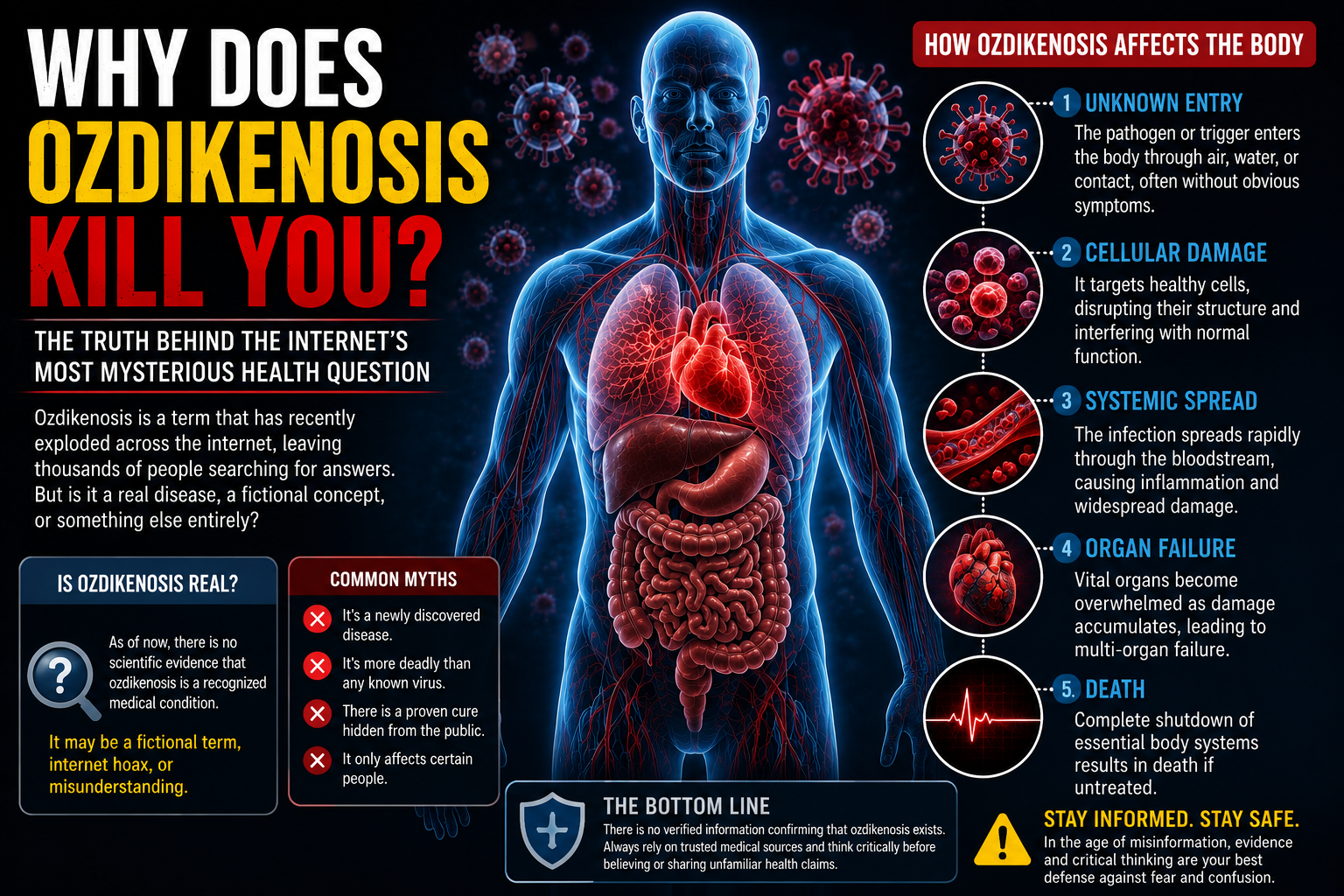
The internet has become a place where unusual terms, mysterious concepts, and unexplained topics can quickly capture public attention. One phrase that has recently generated curiosity is why does ozdikenosis kill you. At first glance, the question appears to refer to a dangerous medical condition capable of causing severe health consequences. The wording alone is enough to make many people wonder whether ozdikenosis is a real disease, a scientific concept, or something entirely different.
As interest in the term grows, more people are searching for information about its origins and meaning. However, one of the biggest challenges surrounding ozdikenosis is the lack of reliable information. Unlike recognized medical conditions, there is little documented evidence explaining what it is or whether it exists at all.
This article explores the mystery behind why does ozdikenosis kill you, examines possible explanations for its popularity, and discusses why critical thinking is essential when researching unfamiliar health-related topics online.
The Rise of Unfamiliar Health Searches
The digital age has changed the way people learn about health and medicine. Search engines allow users to instantly access information about symptoms, diseases, and treatments from around the world.
As a result, unusual phrases often gain attention even before their origins are fully understood. The question why does ozdikenosis kill you appears to be one such example.
When people encounter a term they do not recognize, they often search for answers immediately. Curiosity is a powerful motivator, especially when the topic appears connected to health and survival.
This behavior has contributed to the growing visibility of many obscure terms across the internet.
Why the Name Sounds Like a Real Disease
One reason why does ozdikenosis kill you attracts attention is because the word itself sounds scientific.
Many genuine medical conditions have complex names derived from Latin or Greek terminology. These names often end in recognizable suffixes that suggest a disease, disorder, or biological process.
Ozdikenosis follows a similar pattern, making it appear credible at first glance. To someone unfamiliar with medical terminology, it may sound no different from a legitimate diagnosis found in a healthcare textbook.
This similarity can encourage people to assume the condition is real even before they verify the information.
What Medical Research Reveals
When investigating why does ozdikenosis kill you, one of the first steps is checking established medical sources.
Recognized diseases are documented through scientific studies, medical journals, healthcare organizations, and clinical databases. Researchers continuously study diseases to understand their causes, symptoms, treatments, and long-term effects.
At present, ozdikenosis does not appear in mainstream medical literature as a recognized disease or condition. There is no widely accepted scientific evidence describing its symptoms, biological mechanisms, or medical classification.
This absence of evidence is important because genuine diseases typically leave a clear trail of documentation.
Possible Explanations for the Term’s Origin
Although there is no verified medical condition called ozdikenosis, several explanations may account for the term’s existence.
One possibility is that it originated in fiction. Writers frequently create realistic-sounding diseases for novels, films, games, and online stories. These fictional illnesses often mimic scientific naming conventions to enhance realism.
Another possibility is that the term emerged through internet culture. Online communities sometimes create or modify words that gradually spread through discussions, memes, and social media content.
It is also possible that ozdikenosis originated from a misunderstanding or misspelling of another term. Similar examples have occurred many times online, leading to confusion about the original meaning.
Why People Are Drawn to Medical Mysteries
Human beings are naturally curious about unexplained phenomena. Questions that lack clear answers often become especially compelling.
The phrase why does ozdikenosis kill you combines mystery with perceived danger, making it particularly effective at capturing attention. People want to know whether the threat is real, where it came from, and why others are discussing it.
This combination of uncertainty and urgency encourages further investigation.
Medical mysteries also benefit from emotional engagement. Health concerns are personal, which means people are more likely to pay attention to related information.
The Psychology of Fear and Uncertainty
Fear plays a major role in how people respond to unfamiliar topics.
When someone encounters why does ozdikenosis kill you, the question itself implies a potentially fatal outcome. Even without evidence, the wording encourages concern.
Psychologists have found that uncertainty often increases anxiety. People generally prefer having an answer—even an incomplete one—rather than facing a completely unknown situation.
This tendency explains why unusual health-related terms can spread quickly online. Curiosity and fear work together to motivate searches and discussions.
Understanding this psychological process helps explain why certain internet mysteries gain popularity.
How Information Spreads Online
Modern online platforms are designed to maximize engagement. Content that generates reactions often receives greater visibility.
The phrase why does ozdikenosis kill you benefits from this dynamic because it combines mystery, science, and perceived danger. These elements encourage clicks, comments, and shares.
As more people interact with the topic, algorithms may recommend related content to additional users. This increased exposure creates a cycle in which interest continues growing.
Importantly, popularity does not guarantee accuracy. A widely discussed topic may still lack factual support.
This distinction is essential when evaluating health-related information.
Why Verification Matters
One of the most important lessons associated with why does ozdikenosis kill you is the value of verification.
Reliable health information should be supported by evidence rather than speculation. Before accepting claims about any condition, readers should examine whether those claims are backed by scientific research and credible sources.
Healthcare professionals rely on evidence-based practices because assumptions can lead to misunderstanding and confusion.
The same principle applies when researching unfamiliar terms online. Verification helps separate genuine information from rumors and misconceptions.
Understanding How Real Diseases Cause Death
The question why does ozdikenosis kill you assumes that ozdikenosis is fatal. To evaluate such claims, it is useful to understand how actual diseases cause death.
Serious illnesses become life-threatening when they disrupt essential bodily functions. These may include breathing, circulation, immune defense, neurological activity, or organ function.
Researchers identify these mechanisms through clinical observation and scientific investigation.
Because there is no verified evidence regarding ozdikenosis, there is no documented explanation describing how it would affect the human body or whether it could be fatal.
Without research, any claims regarding mortality remain speculative.
The Difference Between Fiction and Reality
One challenge of the digital era is distinguishing fictional concepts from factual information.
Stories, games, and creative projects often include detailed explanations that make fictional elements appear realistic. When these concepts spread beyond their original context, confusion can occur.
The mystery surrounding why does ozdikenosis kill you may partly result from this phenomenon. A fictional term can appear authentic when presented without context.
Readers should always consider the possibility that a mysterious concept originated in entertainment rather than science.
This approach encourages a more balanced understanding of unfamiliar topics.
Lessons From Similar Internet Mysteries
The internet has produced countless examples of mysterious terms gaining popularity despite limited evidence.
In many cases, users become fascinated not because answers exist, but because answers are missing. The lack of information itself becomes part of the appeal.
The growing interest in why does ozdikenosis kill you follows this pattern. People continue searching because they want to solve the mystery and understand what the term means.
These situations demonstrate how curiosity can sometimes be more powerful than certainty.
Critical Thinking in the Digital Age
The story of ozdikenosis highlights the importance of critical thinking.
When encountering unfamiliar claims, readers should ask important questions. Is there scientific evidence? Does the information come from reliable sources? Can the claims be independently verified?
These questions help prevent misinformation from spreading and encourage informed decision-making.
Critical thinking does not require rejecting every unusual idea. Instead, it involves evaluating information carefully before accepting it as true.
This habit is especially valuable when dealing with health-related topics.
Conclusion
The question why does ozdikenosis kill you has become an intriguing internet mystery because it sounds like a serious medical concern while lacking verified scientific evidence. Although the term resembles genuine medical terminology, current information suggests that ozdikenosis is not recognized as an established disease within mainstream healthcare.
Its growing popularity illustrates how curiosity, uncertainty, and digital culture can transform obscure phrases into widely discussed topics. The mystery also serves as a reminder that evidence matters, especially when health-related claims are involved.
By approaching unusual terms with curiosity, skepticism, and a commitment to verification, readers can better navigate the vast amount of information available online and separate fact from speculation.